

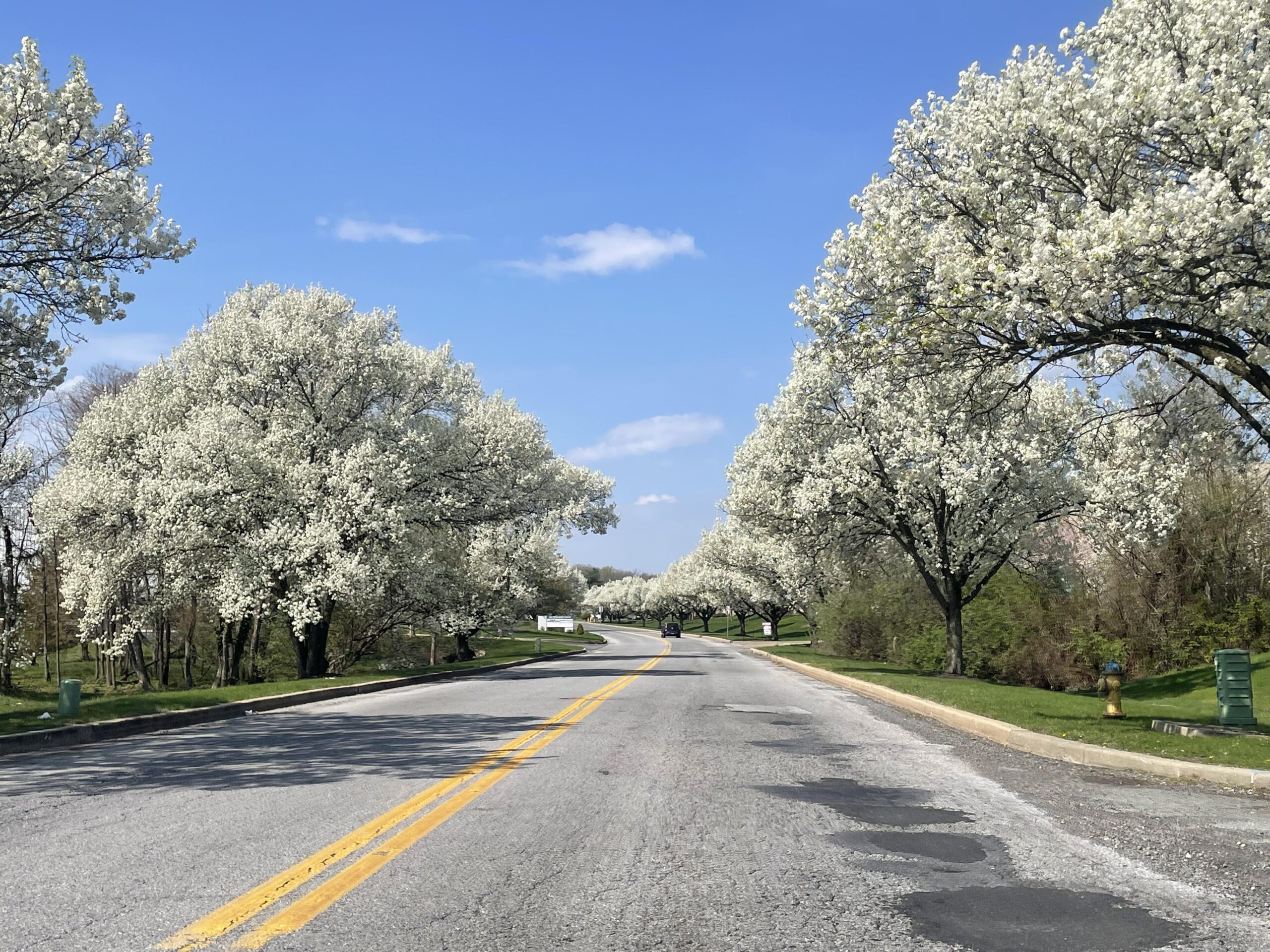
Every spring it happens. You’re driving down Route 38, through Eastampton, through Lumberton, and the roadsides are lined with white flowering trees. Whole stretches of highway look like someone draped them in snow. It’s a pretty picture — until you know what you’re actually looking at.
A lot of those white trees are Bradford Pears. And Bradford Pears are a problem.
But before we get into that, let’s break down all the white-flowering trees you’re likely seeing this time of year in Burlington County, because there are several — and some of them are excellent trees worth planting.
The White Flowering Trees You’re Seeing Right Now
Flowering Dogwood
Dogwood blooms white in mid-spring and is probably the most beloved flowering tree in the entire region. It’s a New Jersey native, meaning it evolved here and belongs here. The white “petals” are actually bracts — modified leaves — surrounding a small cluster of true flowers at the center. The effect is wide, flat, and elegant.
Dogwoods top out around 15–25 feet, do well in partial shade, and have great fall interest with red leaves and red berry clusters that birds love. If you see a white flowering tree in someone’s yard that looks graceful and intentional, there’s a good chance it’s a dogwood.
Yoshino Cherry
Yoshino cherry is the tree that lines the National Mall in Washington D.C. In South Jersey it blooms in late March to early April — white to very pale pink, clouds of single flowers covering the entire canopy before the leaves even come out. The bloom window is short, about 10–14 days, but it’s dramatic while it lasts.
These grow to 20–30 feet with a broad spreading canopy. On a residential street, a mature Yoshino in full bloom stops traffic.

Star Magnolia
Star magnolia blooms early — sometimes the first tree to show white flowers in late March. The flowers are narrow-petaled and slightly shaggy compared to the big bold blooms of saucer magnolia. It stays smaller than most magnolias, typically under 20 feet, and works well in tighter spaces.
The downside is it blooms so early it often takes a frost hit. You’ll see the flowers turn brown at the edges after a cold night. The tree recovers fine, it just ruins that year’s show.
Serviceberry
Serviceberry is a native tree that produces delicate white flowers in very early spring — often the first tree blooming when nothing else has started yet. It’s a smaller tree, 15–25 feet, with good fall color and edible blue-purple berries that birds go crazy for. It’s not as commonly planted as it deserves to be.
Bradford Pear
And then there’s Bradford Pear.
Bradford Pear is everywhere in South Jersey — lining highways, planted in front yards across Burlington County, showing up in commercial parking lots. It blooms heavily in white in early spring, grows fast, and for years was sold as the perfect suburban tree. The problem is that almost everything about that reputation turned out to be wrong.
What’s Wrong with Bradford Pear
It smells terrible
Get close to a Bradford Pear in bloom and you’ll understand immediately. The flowers produce a smell that’s been compared to rotting fish, wet dog, and worse. For two weeks every spring, trees that are close to your house, your patio, or your front door are going to make being outside unpleasant. This is not a small thing.
The branches split
Bradford Pears grow with a tight, upright branching structure where multiple large limbs emerge from nearly the same point on the trunk. That structure is inherently weak. As the tree matures, those branches get heavy, and under the weight of ice, snow, or wind, they split apart. A 20-year-old Bradford Pear coming apart in a storm is a serious property damage risk. This is a well-documented structural failure, not a freak occurrence.
It’s invasive — and New Jersey just took action
This is the part most homeowners don’t know. Bradford Pear was originally marketed as a sterile tree that wouldn’t spread. That turned out to be incorrect. Bradford Pears cross-pollinate with other Callery pear varieties and produce viable seeds that get spread by birds. The offspring — called Callery pears — have large thorns and are extremely aggressive. They invade roadsides, fields, and forest edges, crowding out native plants and providing almost no value to local wildlife.
In January 2026, New Jersey signed the Invasive Species Management Act, which includes Callery pear — the species that Bradford Pear belongs to — on its list of regulated invasive plants. Pennsylvania banned the sale and cultivation of Bradford Pear entirely in February 2024. The direction in New Jersey is clear.
If you look at the roadsides on Route 38 or 295 in spring and see masses of white trees growing wild along the tree line — that’s what escaped Bradford Pear looks like. It’s already here.
You can still buy them — but should you?
Yes, Bradford Pears are still available at some nurseries in New Jersey. That doesn’t mean they’re a good choice. Reputable nurseries are phasing them out. Landscapers who know what they’re doing have moved on. And with NJ regulations tightening, planting one today is a decision you’re likely to regret in a few years.
What to Plant Instead
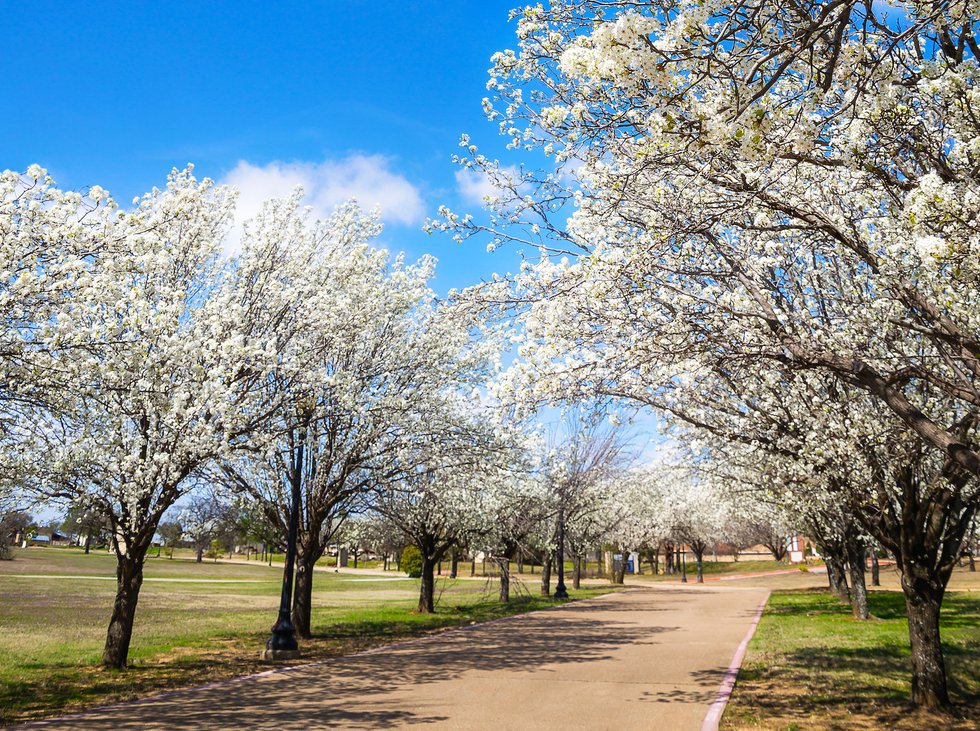
If you want white spring flowers, good structure, and a tree that’s actually going to hold up for 30+ years without causing problems, here are the best alternatives:
Flowering Dogwood — native, white spring bloom, great fall color, manageable size. The right tree for most residential properties in Burlington County.
Yoshino Cherry — dramatic white bloom in early spring, spreads wide, long-lived when properly sited. One of the best pure flowering trees available.
Kousa Dogwood — blooms a little later than flowering dogwood (early summer), white bracts, excellent disease resistance, exfoliating bark that looks good all year. A four-season tree.
Serviceberry — earliest white bloom of any tree in spring, native, wildlife value, great fall color. Underused and underrated.
Crabapple — modern disease-resistant varieties like Prairifire produce white to pink flowers and persistent small fruit that looks good into winter. Extremely adaptable.
All of these give you the white spring bloom you’re after without the smell, the structural risk, or the invasive spread.
The Bottom Line
If you have a Bradford Pear in your yard and it’s healthy, you don’t necessarily have to remove it today. But if you’re planning new plantings, or if you’ve got a Bradford that’s starting to split or lean, that’s your opportunity to replace it with something better.
At Morgan Landscape, we do landscape design and planting throughout Burlington County — Lumberton, Eastampton, Mount Laurel, Westampton, and the surrounding towns. If you’re not sure what you’re looking at in your yard, or you want to talk through what to plant, we’re happy to help.