

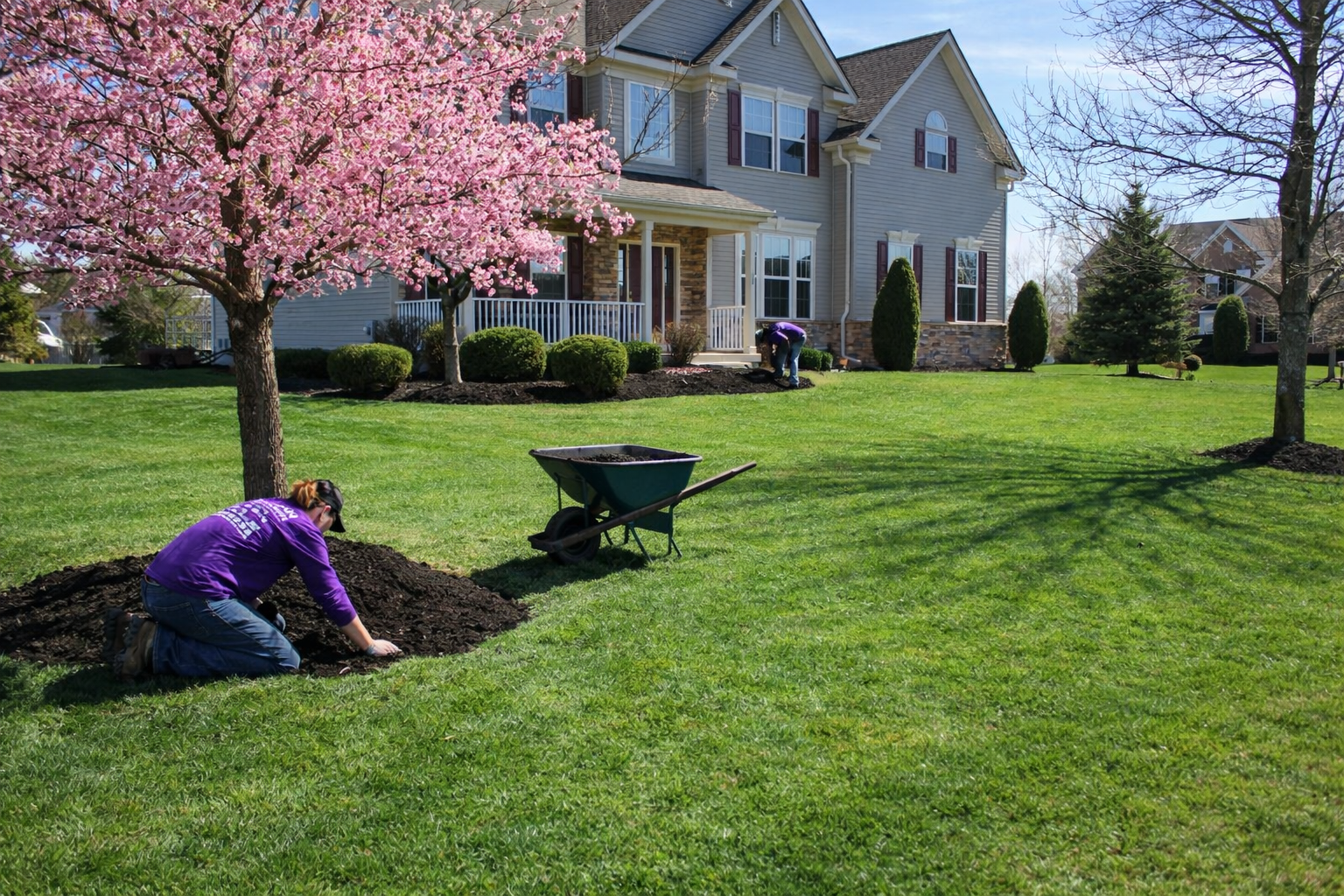
If there’s one landscape service that delivers the most visible impact for the investment, it’s mulching. Fresh mulch transforms the look of a property immediately — clean beds, defined edges, rich color against green grass. But the benefits go well beyond curb appeal. Mulching in spring is one of the most practical things you can do for the health of your landscape going into the growing season.
Here’s what it does, when to do it, and what to watch out for.
What Spring Mulching Actually Does for Your Plants
Mulch isn’t just decorative. It’s doing real work in your landscape beds throughout the season.
Moisture retention is one of the biggest benefits. A proper layer of mulch slows evaporation from the soil, which means your plants hold onto moisture longer during dry stretches and summer heat. South Jersey summers get hot and dry — mulched beds handle that stress significantly better than bare soil.
Weed suppression is the other major practical benefit. Mulch blocks sunlight from reaching the soil surface, which prevents weed seeds from germinating. You’ll never eliminate weeds entirely, but a properly mulched bed with a pre-emergent treatment applied underneath will have dramatically fewer weeds than an unmulched bed all season long.
Root insulation matters in early spring when soil temperatures are still fluctuating. Mulch acts as a buffer, keeping roots protected from late cold snaps and temperature swings that can stress plants coming out of dormancy.
Soil health improves over time as organic mulch breaks down and adds nutrients back into the soil. It’s a slow process but a real one — well-mulched beds tend to have healthier, more established plants over the years.
What the Process Looks Like
A professional mulch installation isn’t just dropping material on top of whatever is already there. Done properly, it involves several steps before a single bag of mulch goes down.
At Morgan Landscape, our mulch service typically includes:
- Bed cleanup — removing weeds, debris, and most of the old mulch from the previous season
- Edging — beds are cut with a spade to create clean, defined lines between the mulch and the lawn. This is the step that makes the biggest visual difference and separates a professional job from a DIY one
- Shrub trimming — shrubs are shaped before mulch goes in so the finished product looks clean and intentional
- Pre-emergent application — a weed prevention treatment is applied to the soil before mulch is installed, adding a chemical barrier on top of the physical one the mulch itself provides
- Mulch installation — material is spread evenly at the right depth throughout the beds
That sequence matters. Skipping steps — especially edging and pre-emergent — produces a noticeably inferior result.
How Much Mulch Is the Right Amount
Two inches is the target. Not one, not four — two inches is the depth that provides the moisture and weed suppression benefits without creating problems.
The most common mistake we see — from both homeowners and inexperienced landscapers — is piling too much mulch against trees. Over years of over-mulching, a mound builds up around the base of the tree. This traps moisture against the bark, invites disease and insects, and can eventually damage or kill the tree. It’s called volcano mulching, and it’s everywhere.
If this has happened on your property over several years, the mulch layer may have hardened and compacted with roots growing through it — at that point you can’t always reverse it completely. But you can stop making it worse by applying the correct amount going forward and keeping mulch pulled away from the trunk.
What Color Mulch Should You Choose
Black dyed mulch is by far the most popular choice among our clients in Burlington County, and for good reason — it provides strong contrast against green plants and grass, stays visually rich longer than natural mulch, and works with virtually any home exterior color.
Dyed brown is the second most popular option. It has a more natural, earthy look that some homeowners prefer, particularly on properties with a lot of wood tones or more naturalistic landscaping.
Red mulch has fallen significantly out of favor in recent years. Even commercial properties and national chains that used to specify red have moved away from it in recent redesigns. Our primary supplier no longer carries red due to lack of demand — we source it from a secondary supplier for the clients who still prefer it, but it’s becoming less common each season.
Ultimately it comes down to personal preference and what complements your home. If you’re unsure, black is the safe choice — it works on almost everything.
When Should You Mulch?
This is more flexible than most people think. There’s no single correct answer — it comes down to preference and scheduling.
Some clients want mulch down in March as soon as the season opens. Commercial properties are typically our first priority and are often completed in early March. Many residential clients prefer April or May. Others deliberately wait until June after the spring rains and pollen season have passed, so the fresh mulch doesn’t immediately get coated in yellow dust or washed around by heavy rain. Some clients prefer July specifically because the color stays richer and more vibrant longer into the summer when it goes down later in the season.
All of these are valid approaches. The right time is the time that works for your property and your preference.
Should You Mulch in the Fall Too?
Some of our clients mulch twice a year — once in spring and again in the fall, typically before the holiday season. Fall mulching has its own set of benefits worth considering.
Fresh mulch in November gives your beds color during the winter months when plants are dormant and beds can look bare. It looks particularly good through the holiday season when your property gets more attention and visitors. Beyond aesthetics, fall mulch also helps insulate plant roots going into winter, protecting them from freeze-thaw cycles that can stress root systems.
If you’ve been happy with how your property looks in spring after mulching, a fall application is worth considering to maintain that appearance year-round. We can add it to your schedule alongside your spring service.
Ready to Schedule Your Spring Mulch?
Morgan Landscape handles mulching throughout Burlington County including Lumberton, Mount Laurel, Moorestown, Hainesport, Westampton, Mount Holly, Medford, Marlton, and surrounding South Jersey communities.
We schedule mulch jobs year round and build our client schedules in advance — so the earlier you reach out, the better position you’ll be in for the timing you prefer.