

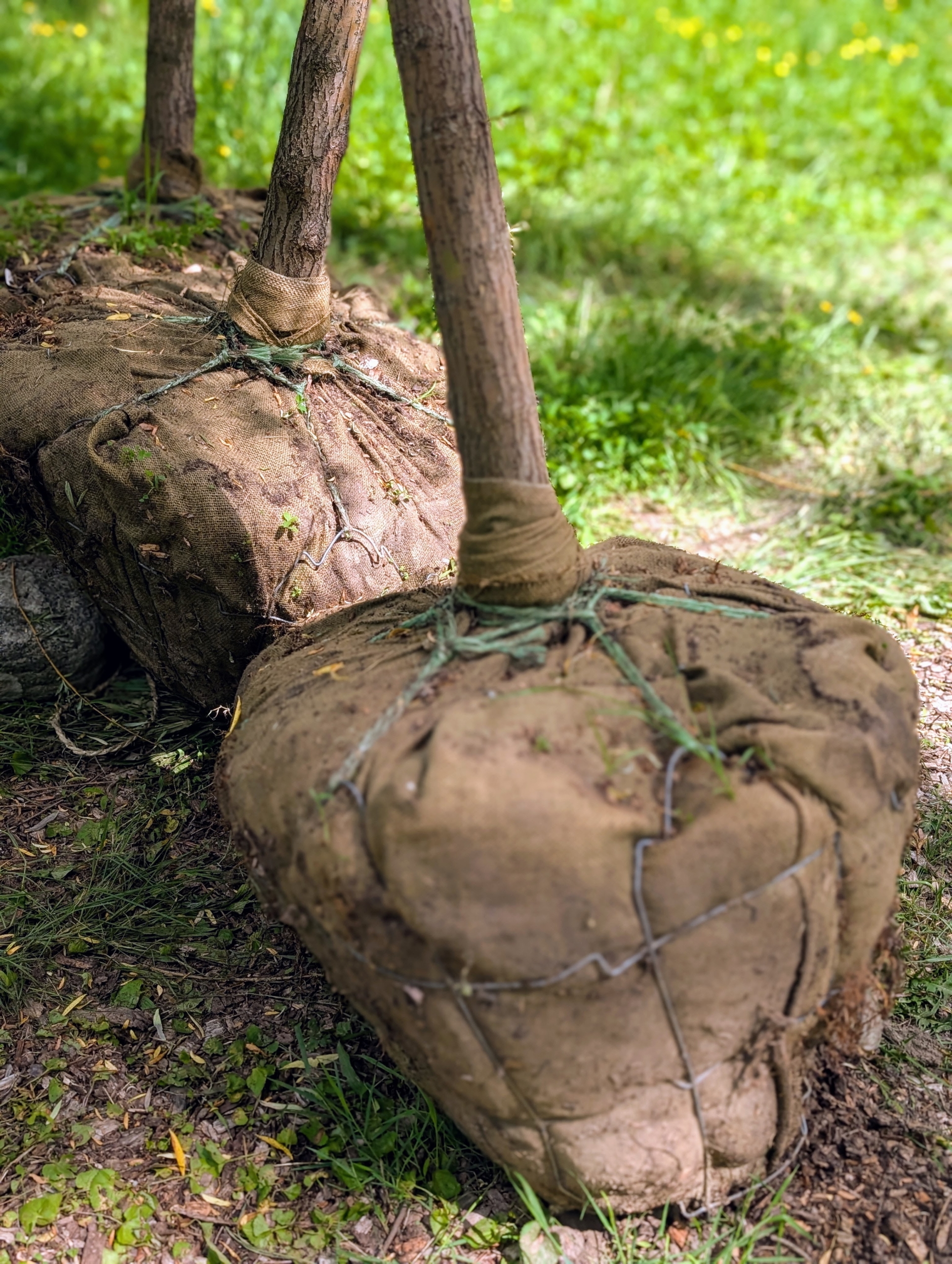
If you’ve done any research on planting trees, or watched a landscaper work before, you’ve probably come across this question: should you untie the root ball, open the burlap, and remove the wire basket before planting?
It’s one of those topics in landscaping where you’ll find strong opinions on both sides. Homeowners have their own beliefs, professionals have theirs, and university horticulture programs have published recommendations that don’t always match what experienced growers do in the field. Landscaping is full of debates like this — techniques passed down through generations, things people swear by, and genuine disagreements even among experts.
Here’s where we stand at Morgan Landscape, and why.
What Is a Balled and Burlapped Tree?
When trees are grown at a nursery, they’re planted in the ground in field rows and carefully root-pruned over time to keep the root system compact and close to the base of the plant. When it’s time to sell them, they’re dug up and the root ball — that dense mass of roots and soil — is wrapped in burlap and secured with rope or twine. On larger trees, a wire basket is used to further support and contain the root ball. This is called a balled and burlapped tree, or B&B.
The burlap, rope, and twine are all biodegradable. Left in the ground, they break down naturally over time and roots grow right through them without issue.
The Debate — Should You Open It?
The widespread belief — and what some university extension programs recommend — is that you should untie the root ball, pull back or remove the burlap, and cut away the wire basket before or after placing the tree in the hole. The reasoning is that you’re removing any potential barrier between the roots and the surrounding soil.
We respect that recommendation and understand where it comes from. But our experience, and the guidance we follow, points in a different direction.
Why We Leave the Burlap and Basket Intact
Our position comes directly from the farm that grows the trees we plant. This is a three-generation wholesale tree growing operation — these are people who have grown and dug thousands of trees and watched what happens when they go in the ground under every kind of condition. We take their guidance seriously, and our own experience planting hundreds of trees without opening burlap has consistently backed them up.
Their reasoning is practical and straightforward.
A newly planted tree is not yet rooted into its new environment. The root ball is its entire foundation until it establishes itself in the surrounding soil. In that vulnerable window, wind is the biggest threat.
Here’s what happens when a tree tips in the wind:
If the root ball is tied and intact, the tree and root ball tend to tip together as one unit. The ball stays connected. You can go out after a storm, push the tree back upright, re-pack the soil, and the tree has a real chance of recovering. We’ve done this many times — it’s a fixable situation.
If the root ball has been loosened — burlap opened, ties cut, basket removed — and that tree gets hit by wind and tips, the trunk can snap away from the root ball entirely. The tree separates from its base. At that point it’s not savable. What would have been a recoverable situation becomes a total loss.
The same logic applies to wire baskets. On larger trees, the root balls are often too big and heavy to safely remove the basket without disturbing or cracking the ball anyway. We leave the basket in place. Tree roots grow right through wire with no problem, and the basket breaks down in the ground over time.
So is the University of Maryland wrong? Not necessarily — this is a genuine debate in horticulture. But we’re siding with three generations of hands-on growing experience and hundreds of successful plantings. The burlap stays tied.
Don’t Plant Too Deep — This Matters More Than the Burlap
Here’s something that doesn’t get discussed enough and causes more long-term tree problems than most people realize: planting depth.
Trees should never be planted so deep that the trunk base gets buried. The spot where the trunk meets the roots — called the root flare or root collar — should be at or very slightly above ground level when planting is complete. Burying the trunk even a few inches can restrict root oxygen, invite disease, and lead to what’s called girdling roots, where roots wrap around the base and slowly strangle the tree over years.
A good rule of thumb: the root ball itself should sit slightly above grade, with a light layer of mulch applied around it to help retain moisture. Keep the mulch away from the actual trunk — you want the bark to stay dry. A volcano of mulch piled up against the trunk is one of the most common planting mistakes we see.
You Can Plant Trees Any Time the Ground Can Be Worked
This is a misconception worth clearing up. Most homeowners assume trees can only be planted in spring or fall. That’s simply not true for balled and burlapped trees.
Because B&B trees are already removed from the ground and sitting at a nursery in a self-contained root ball, moving them into a hole in your yard doesn’t disturb the plant. You’re not digging them out of the ground in summer — that would be harmful. These trees were already dug, most likely during dormancy in winter months, and have been sitting above ground at the nursery ever since. Placing them into the ground is not harmful regardless of the season, as long as the ground can be worked.
Summer planting is perfectly viable. The tree will need consistent watering through the heat while it establishes, but there’s nothing wrong with the planting itself.
Winter planting is also possible and actually very safe. A dormant tree is essentially in protected mode — water isn’t actively moving through it, and it’s not trying to grow. Think of a Christmas tree cut in winter that stays green for weeks, versus a tree cut in summer that would drop its needles in days. A dormant arborvitae moved from a nursery into the ground will simply stay dormant until spring, then begin establishing its root system as temperatures rise.
We’ve planted trees in the middle of winter for developers and contractors who needed landscaping completed before a project closed. Planted in December, rooted in by spring. It works.
So if you’re thinking about adding privacy trees to your South Jersey property, don’t wait for a specific season. As long as the ground isn’t frozen solid, we can get them in the ground.
A Quick Note on Watering and Fertilizing After Planting
Once your trees are in the ground, consistent watering through the first growing season is important. The root system is still establishing itself in new soil and needs support. After that first year, most trees become significantly more drought tolerant and require far less supplemental watering.
Fertilizing in early spring and fall will help accelerate growth during the establishment period. Avoid fertilizing in summer — trees shift into a protective mode during heat and pushing growth at that time can work against them.
Thinking About Adding Trees to Your South Jersey Property?
Morgan Landscape plants trees and privacy screens throughout Burlington County — including Lumberton, Mount Laurel, Moorestown, Hainesport, Westampton, Mount Holly, Medford, Marlton, and surrounding South Jersey communities.
If you’re specifically looking at privacy trees, check out our full guide to Green Giant vs. Emerald Green Arborvitae — it covers growth rates, deer resistance, spacing, size selection, and everything else you need to make the right choice.