

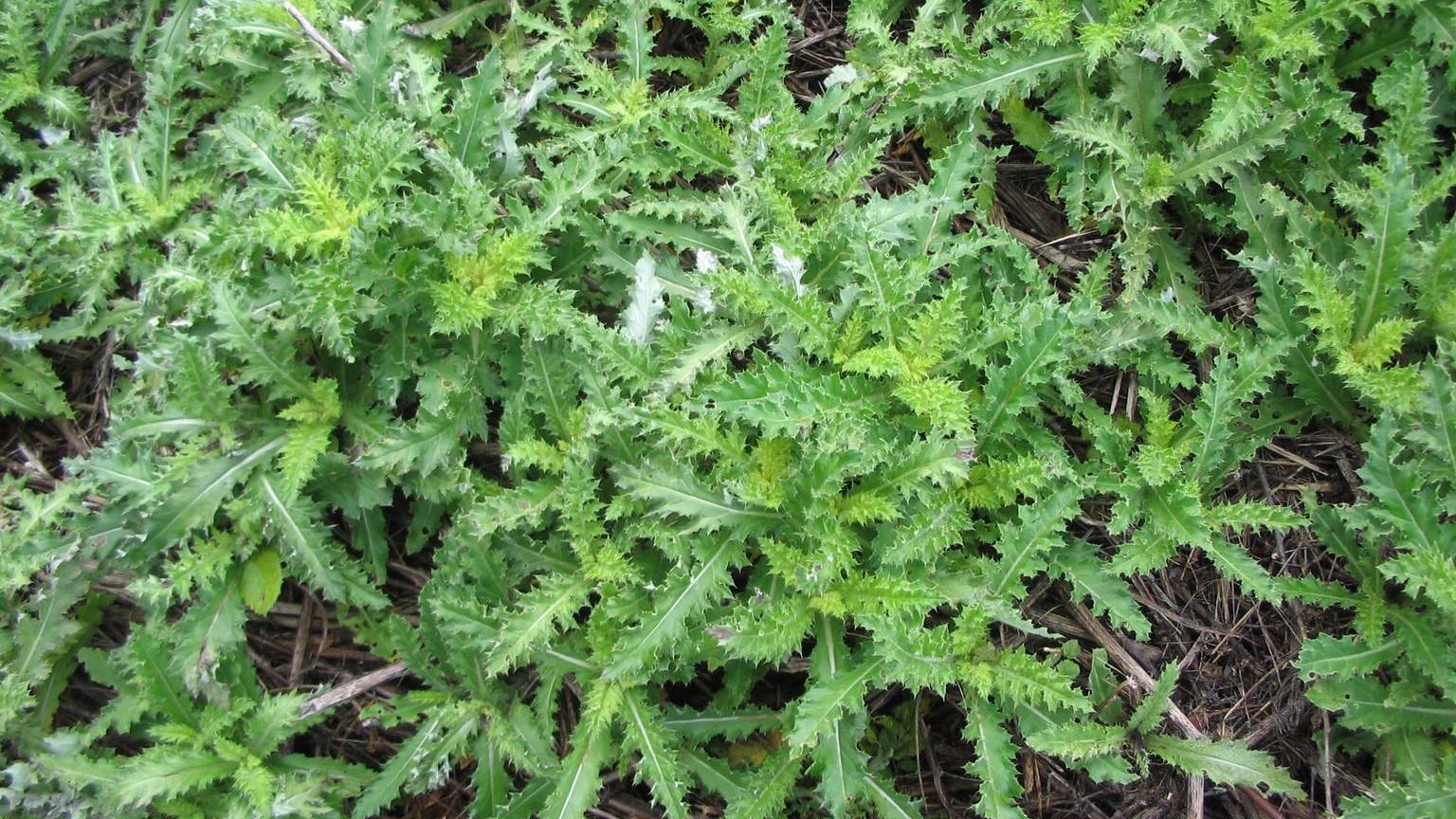
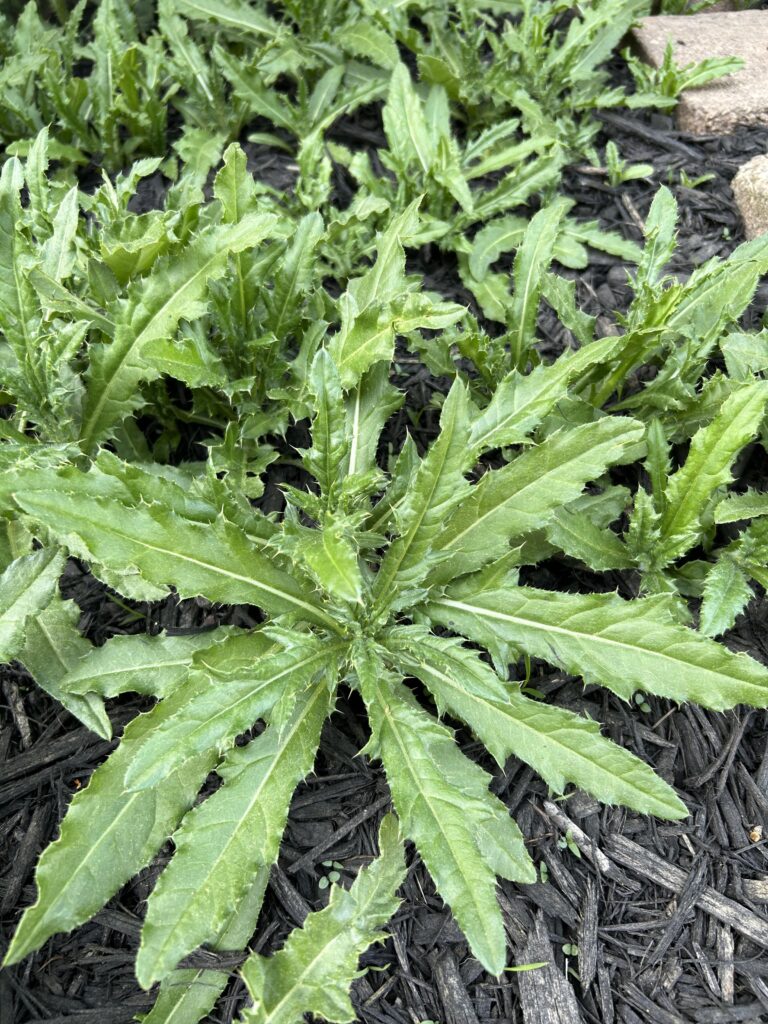
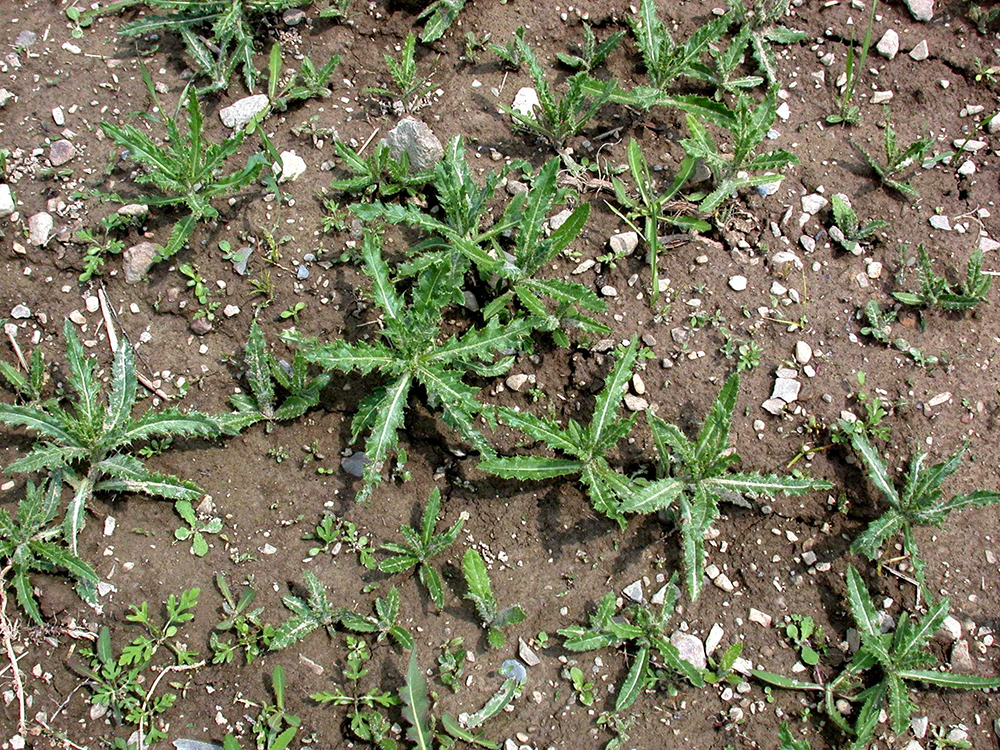
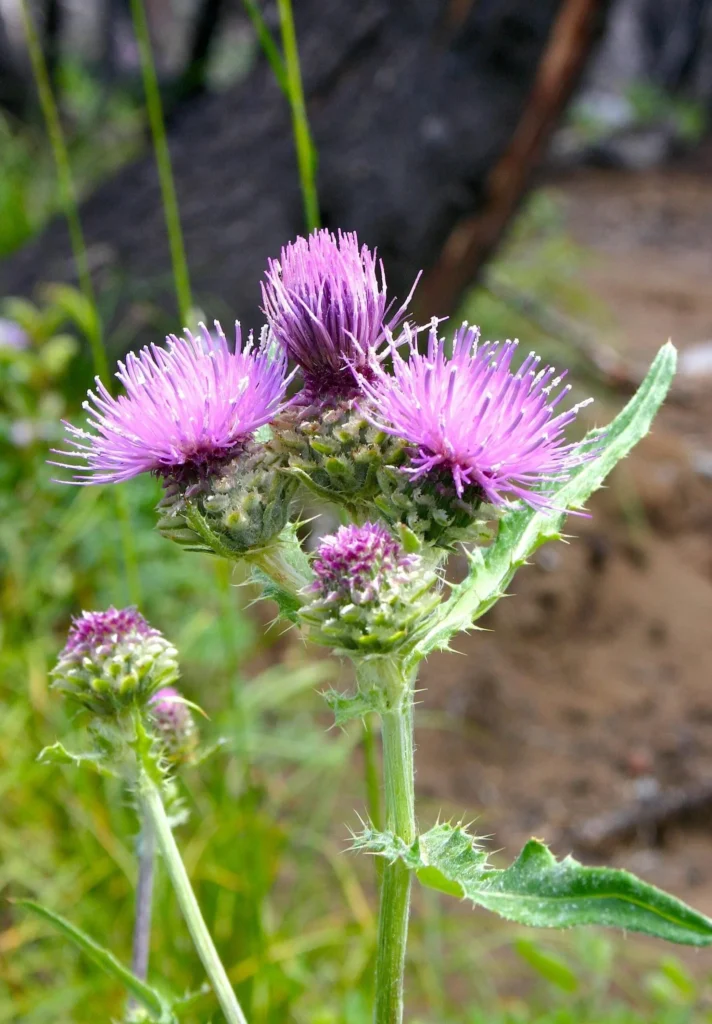
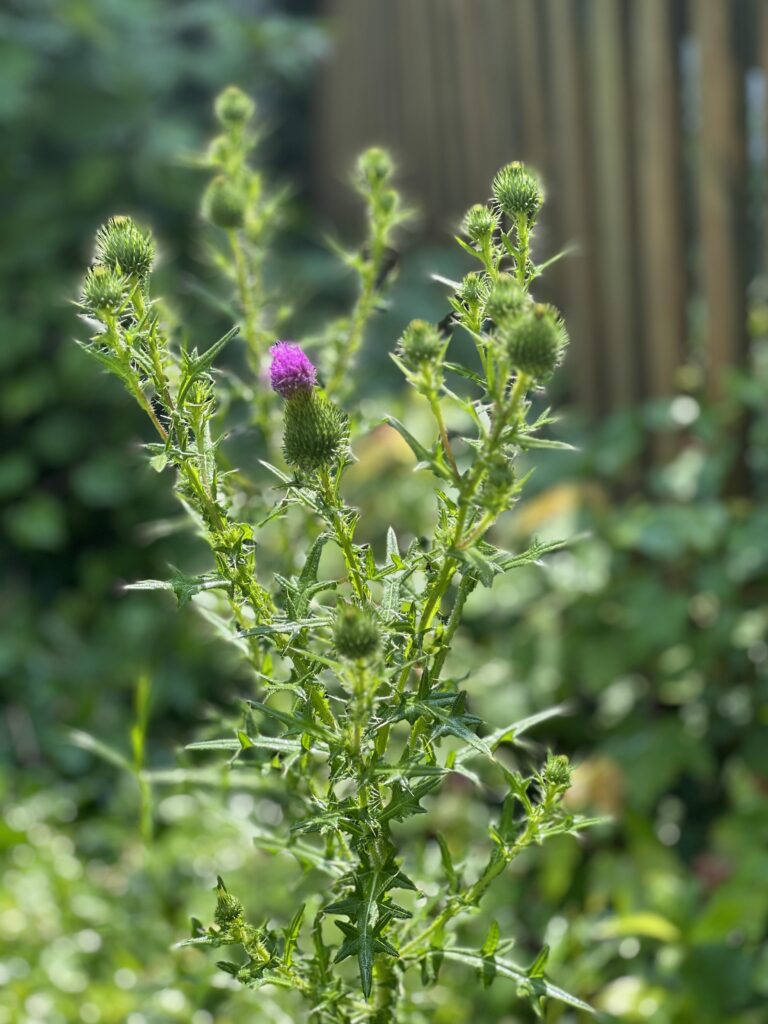
There’s a weed that shows up in landscape beds across Burlington County every spring, and once it gets established, it becomes one of the most frustrating problems a homeowner can deal with. You’ve probably seen it — or felt it. Stiff, spiny leaves with sharp points along the edges that prick your hands when you try to pull it. Upright stems that can reach two to three feet tall. Small purple or lavender flower heads in midsummer that look almost pretty until you realize what they are. It grows in clusters, spreading outward from a central area, and no matter how many times you pull it, it comes back.
That’s Canada thistle — and it is not a normal weed.
Annual Weeds vs. Perennial Weeds — Why It Matters
Most of the common weeds homeowners deal with are annuals. An annual weed grows from seed, lives out its season, and dies. Pull it before it goes to seed and it’s gone. Even if you miss some and they do seed, you’re dealing with new plants from scratch the following year. Dandelions, chickweed, crabgrass — these are manageable with a consistent cleanup routine because you’re interrupting a cycle that resets every year.
Canada thistle is a perennial weed. That means it does not die at the end of the season. It does not need to reseed itself to come back. It goes dormant in winter and returns every spring from the same living root system — stronger, wider, and more established than the year before. You are not dealing with a new weed every year. You are dealing with the same organism, still alive underground, that has been growing since it first arrived in your bed.
This distinction is everything when it comes to understanding why thistle behaves the way it does.
What’s Happening Underground
The reason Canada thistle is so difficult to control comes down to what’s happening below the surface — and it’s more extreme than most people realize.
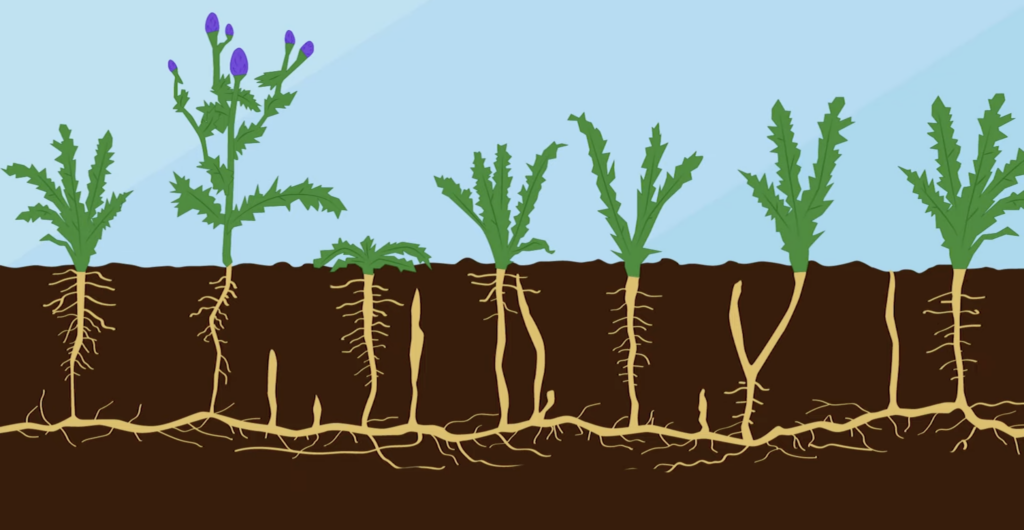
Canada thistle has an extensive underground root system with what are called rhizomes — horizontal underground stems that spread outward in all directions just below the soil surface, constantly sending up new shoots as they go. Think of it like a web that the plant uses to travel. Every point on that web is capable of producing a new plant. The web itself keeps growing.
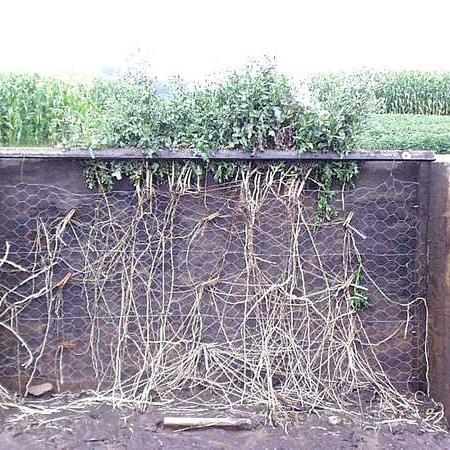
Here’s how extreme it gets: the root system of an established Canada thistle can penetrate the soil six to ten feet deep. Not inches — feet. The lateral roots spreading horizontally can extend up to twenty feet in every direction from the visible plant. A single plant can produce over one hundred yards of root growth in just eighteen weeks.
What this means practically is that the thistle you see growing in your landscape bed is connected underground to roots that have already traveled under your lawn, under the bed edging, under neighboring shrubs, and potentially into the yard next door. The plant above ground is just the visible portion of a much larger organism living below it.
This is why fresh mulch doesn’t stop it. The roots are already below where the mulch sits. Putting mulch on top of a thistle infestation doesn’t address what’s underground. The plant doesn’t care what’s on the surface.
Why It Comes Back After a Cleanup
When landscape beds get cleaned — even thoroughly — the visible thistle is removed. What cannot be removed by hand is the root system, because those roots extend far beyond the bed and go deeper than any manual removal can reach.
Within days of removing the top growth, the underground root system sends up new shoots. Within two weeks, you have visible thistle again. A bed that looked perfect at the time of the mulch service is showing weeds again, and the natural assumption is that something was done wrong or missed.
Nothing was missed. The bed was cleaned to everything that was visible above ground. The root system below the surface was never touched — because hand cleaning cannot reach it.
There’s another layer to this that makes it worse: pulling thistle by hand actually stimulates more growth. When roots are disturbed and fragmented during pulling, each fragment left in the soil is capable of generating a new plant. Root fragments as small as half an inch can produce a new thistle. Aggressive hand pulling doesn’t remove the plant — it can multiply it. This is exactly the opposite of how most weeds work, and it’s why thistle needs to be approached differently.
Does Landscape Fabric Help?
Landscape fabric under mulch is heavily marketed to homeowners as a weed control solution — you’ve probably seen it on store shelves with photos of mulched beds right on the label. In practice, for invasive perennial weeds like thistle, it doesn’t solve the problem. And we generally don’t recommend it under mulch regardless of the weed situation.
Here’s what actually happens over time: fabric sits at the soil surface, mulch goes on top. Mulch breaks down into organic material, and that layer accumulates on top of the fabric. Weed seeds blow in, land in that decomposed organic layer, and germinate right on top of the fabric — they never even need to penetrate it. Within a season or two you have weeds growing in the mulch itself, and now you have fabric buried underneath making the bed harder to work with and replant. The cost of the material and labor to install it rarely justifies benefits that tend to be short-lived.
For Canada thistle specifically, fabric provides no barrier at all. The root system driving thistle regrowth is already six feet below the surface. The plant pushes right through or around any fabric installation.
Under rock and hardscape it’s a different story — rock doesn’t break down into organic material the way mulch does, fabric stays effective underneath it, and it genuinely prevents weeds from establishing. Under organic mulch in planted beds, it’s not a tool we recommend.
What About Removing All the Soil?
Complete soil removal and replacement is sometimes considered for severe infestations, and the logic makes sense — if the roots are in the soil, remove the soil.
The problem is that the root system has almost certainly already extended well beyond the bed boundaries before the decision to remove soil gets made. Roots traveling twenty feet horizontally don’t stop at the bed edge. They’re already under the lawn, under the edging, and into surrounding areas. Removing soil inside the bed doesn’t affect roots that are already fifteen feet away in the lawn — and those roots will send new shoots into the freshly cleared bed within weeks of the renovation.
Soil disturbance during removal also carries the risk of fragmenting existing roots and spreading them further into the bed and surrounding areas. And Canada thistle seeds can remain dormant in surrounding soil for up to twenty years — a seed bank that replacing one bed’s worth of soil cannot address.
Full soil removal can be part of a plan for an extreme situation, but it needs to be paired with an ongoing spray program to manage regrowth from surrounding root systems. Without that, the bed will be reinfested from the edges regardless of how clean the soil inside it is.
The Seed Problem
Beyond the root system, Canada thistle also reproduces by seed. A single plant can produce up to five thousand seeds that can germinate within ten days and remain dormant in the soil for up to twenty years.
This means a property that has never had visible thistle can develop an infestation from seeds that blew in from a neighboring property, a roadside, or an open field. Burlington County has significant thistle pressure along roadsides and open areas throughout the region — seeds travel on the wind and establish wherever bare or disturbed soil gives them an opening. Fresh mulch installation disturbs the soil surface, which is one reason pre-emergent treatment at the time of mulching matters alongside everything else.
What Actually Works — A Treatment Program, Not a One-Time Fix
Canada thistle cannot be eliminated in a single treatment. What a professional program can do is wage a war of attrition against the root system — depleting its energy reserves season by season until the infestation shrinks to a manageable maintenance level. That process takes two to three seasons of consistent treatment.
Here’s what that program looks like:
Early spring pre-emergent — March
Before the growing season begins, a pre-emergent herbicide is applied to the beds. Pre-emergent creates a barrier in the soil that prevents seeds from germinating — it addresses the seed bank and stops new thistle seedlings from establishing alongside the existing root problem.
This needs to happen in early March in South Jersey, before soil temperatures climb to fifty degrees. Clients who only receive pre-emergent at mulch time — May or June in some cases — are missing the most critical application window of the year.
Important to understand: pre-emergent addresses seeds only. It has no effect on the existing root system already in the ground. It is one layer of the program, not the whole program.
Pre-mulch spray — one to two weeks before the mulch service
All visible thistle gets treated with a systemic post-emergent herbicide. Systemic means the herbicide is absorbed through the leaves and travels down through the plant into the root system — it doesn’t just burn the top, it works its way underground. Applying this one to two weeks before the mulch service allows the herbicide to fully move through the plant and begin killing the root system.
By mulch service day, treated plants are dead or dying. That dead material gets removed during the bed cleanup, and fresh mulch goes down over clean beds.
Pre-emergent at time of mulching
A second pre-emergent application at mulch time recharges coverage and addresses any seeds disturbed by the installation itself, since the March application has been active for six to eight weeks by that point.
Monthly spot treatment — spring through summer
New shoots will come up through the mulch. This is expected and is not evidence of a failed treatment — it is the root system spending its stored energy to push up new growth. The approach is to spray those shoots while they are small, before they can photosynthesize and send energy back down to the roots.
This is where the war of attrition happens. Every shoot that gets killed before it can feed the root system is energy the plant spent and didn’t get back. The root system has finite energy reserves. Monthly consistent treatment depletes them progressively, and each season the plant comes back weaker than the last.
Fall spray — September through October
This is the single most important treatment of the year.
In late summer through fall, Canada thistle shifts its energy flow downward — drawing energy from top growth into the root system to store for winter. A systemic herbicide applied during this window gets carried down with that energy flow, directly into the roots. It travels deeper and does more damage to the root system than spring and summer applications can achieve. A well-timed fall application often accomplishes more than multiple summer visits combined.
This application should never be skipped. It is the cornerstone of the entire program.
What to Expect — Honest Timeline
Year one: Beds look clean after the pre-mulch spray and fresh mulch installation. Monthly spot treatments keep regrowth managed. The fall spray hits the root system hard going into winter.
Year two: Noticeably less regrowth between monthly treatments. The root system is weaker and the retreatments take less time. The program starts to feel like it’s gaining ground.
Year three: The population is substantially reduced. Thistle is at a maintenance level — occasional new growth that gets handled quickly — rather than an active infestation requiring constant attention.
The alternative is doing nothing, which means a larger, more deeply established infestation every season that becomes progressively harder and more expensive to address.
The Bottom Line
Canada thistle is not a weed that responds to a single cleanup. Its root system is too deep, too wide, and too persistent for any one-time approach — whether that’s hand pulling, landscape fabric, soil removal, or a single spray — to solve on its own. What works is a consistent program of timed pre-emergent treatment, systemic spraying before and during the season, monthly follow-up, and a well-timed fall application as the most critical piece.
If your landscape beds have thistle that keeps coming back season after season, the answer is a program designed specifically for how this weed works — not more of the same approach that isn’t getting ahead of it.
Morgan Landscape manages Canada thistle and other invasive perennial weeds throughout Burlington County. If your beds have a persistent thistle problem, we can put together a treatment plan for your property.
We serve Lumberton, Eastampton, Mount Laurel, Westampton, and the surrounding towns.